

If you've felt that every other business has AI sorted while you're still working out what to do with it, here's some good news. They probably haven't.
Depending on which UK survey you read, the share of businesses using AI is anything from 6% to 54%. That's a huge range, and all of these studies come from credible organisations.
The numbers, side by side
| Source | What it measured | Figure |
|---|---|---|
| British Chambers of Commerce with Atos, March 2026 | Firms actively using AI, about 94% of them SMEs | 54% |
| Simply Business, summer 2026 | Small business owners using AI tools | 47% |
| ONS, June 2026 | Firms with 10+ staff using at least one AI technology | About 35% |
| ONS, June 2026 | Firms with fewer than 10 staff | 28% |
| Enterprise Nation, June 2026 | Micro and small firms using AI regularly | 21% |
| Enterprise Nation, June 2026 | Firms with AI embedded in daily work across the business | 6% |
They don't really contradict each other. They ask different questions of different groups of businesses. Asking "have you used it?" gets you one number. "Do you use it regularly?" gets you a much smaller one. "Is it built into how the whole business runs?" gets you 6%.
That last gap is the interesting bit.
Trying it and building it in are different things
Picture three businesses.
The dabbler has a ChatGPT login. The owner uses it to tidy up emails now and then. It's handy and it costs little, but the business runs just as it did before. Simply Business found 33% of owners use AI only for routine admin tasks, and just 19% call themselves very confident using it day to day.
The regular has a few people using AI every week for drafting and research. Time gets saved, but each person does it their own way and it all depends on them remembering to.
The embedded business has AI wired into an actual process. An enquiry arrives and something happens automatically, with no one needing to remember. It runs at 2am. It runs when your best person is on holiday.
Most of the headline adoption figure is the first two. Most of the lasting benefit, we'd argue, sits with the third, because that's where work actually comes off someone's plate.
What the surveys say about jobs
There's a fear that "embedded" means fewer people. So far the evidence doesn't show much of that. In the BCC research, 95% of SMEs using AI said it had no impact on the size of their workforce over the past year, and 86% said job roles were unchanged. In the ONS data, about half of businesses said AI had no effect on headcount.
That doesn't settle the long-term question, and the BCC notes that firms adopting deeper, bespoke AI are more likely to expect cuts. But for most small businesses today, the practical story is people getting their time back.
Should you be worried about being behind?
A bit of perspective first. Enterprise Nation found 34% of one-person businesses use AI at all, against 68% of firms with 50 to 249 staff. The BCC found that smaller firms, consumer-facing businesses and manufacturers are lagging. In the IONOS and YouGov survey, 63% of UK decision-makers thought they could stay competitive for two years without AI.
So nobody needs to panic. But Enterprise Nation's 6% cuts both ways. If very few of your competitors have built AI into how they work, there's still an opening for anyone who does it properly.
What "built in" looks like
These are four things we've made at Just Creative People, and none of them is a chat window that someone has to remember to open.
The Just Creative People Client Portal runs our own client projects. Clients sign agreements online, approve each stage, pay by card or bank transfer and see exactly where things stand.
The Beehive Legal AI Voice Agent answers out-of-hours calls. It explains the firm's services, books calls through calendar integrations, follows up by email and sends leads to the CRM.
The Google Ads Campaign Checklist for Cambridge Xyz gives clients a private link to fill in their brief, while the team signs off every check before and during a campaign, with progress visible in one place.
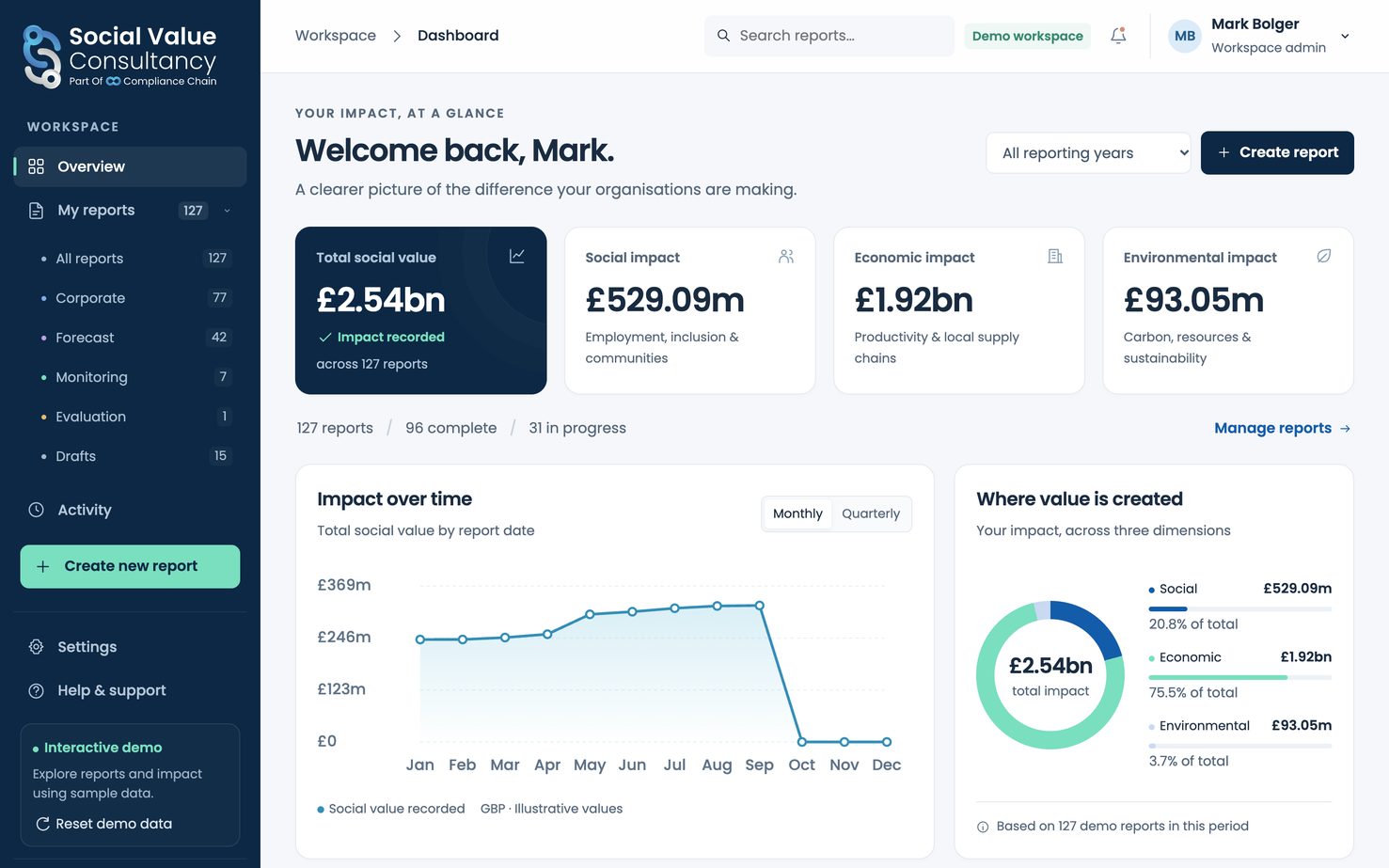
The Social Value dashboard for Social Value Consultancy shows social, economic and environmental impact at a glance, with impact over time and a searchable library of reports.
They all do different things. What they share is that each one is part of a process rather than a tool sitting off to the side.
Moving from dabbling to built in
You don't need a big programme to do this.
- Find out what's already happening. Ask your team what they're using. You may be surprised, and it will show you where the demand is.
- Pick one process with a clear start and end. "An enquiry comes in and gets a reply" is a process. "Marketing" isn't.
- Connect it. The step up from dabbling is usually linking AI to the systems you already use.
- Keep a person in charge. Decide who checks what, particularly anything customers will see.
- Measure it. Note how long the job takes today, then look again in three months.
Do that once and you'll already be doing something that, on Enterprise Nation's numbers, very few UK small firms have managed.
Ready to move from dabbling to something that really works? Book a free 20-minute chat.See our AI & automation service
Contact us →