

Most AI advice starts with a list of tools. Fifty apps, a few affiliate links, and you're left wondering what any of it has to do with your business.
You're not alone in that. In Simply Business's 2026 survey of 1,842 UK small business owners, 39% named not seeing a clear use for AI as a barrier. So let's come at it from the other end. Forget the tools for ten minutes and look at the work.
The test: five questions for any job
Write down the jobs that eat your week. Be specific: "typing supplier invoices into the accounts system", not "admin". Then ask five questions of each one.
- Does it happen often? A job done 40 times a week is worth automating. A job done twice a year usually isn't.
- Does it follow a pattern? If you could train a sensible new starter with a one-page guide, AI or automation can probably help.
- Is it mostly words or data? Emails, forms, documents, enquiries and spreadsheets are home turf. Fixing a boiler is not.
- Can a person check the result quickly? Reading a draft takes seconds. Writing it from scratch takes much longer. That gap is your saving.
- What happens if it goes wrong? A clumsy first draft of a social post is harmless. A wrong figure in a legal letter is not.
Four or five yeses and you've found a candidate. One or two and you can leave it alone without guilt.
Where the savings tend to show up
Businesses already using AI are mostly pointing it at their own operations. The ONS found that improving business operations was the most common purpose, reported by close to 60% of AI-using businesses across all size bands. Among the small business owners using AI in the Simply Business survey, 63% use it to create content and 46% use it to save time on admin.
In practice, these are the places we'd look first.
Enquiries that arrive when nobody's there. Evening calls and weekend web forms often sit waiting. An assistant can answer common questions, collect the details and book the next step, then hand over to a person.
Admin that gets typed twice. If someone copies information from an email into a spreadsheet and then into something else, that's a connection waiting to be made. It often doesn't even need AI. Plain old automation will do.
Chasing. Invoices, missing documents, sign-offs. Nobody enjoys it, it's usually forgotten when you get busy, and most of it is the same message with different names.
First drafts. Product descriptions, follow-up emails and proposals, written in your voice and then checked by a human being who knows the business.
Finding information. If your team keeps asking the same person where the price list is, an assistant trained on your own documents can answer in seconds.
Where it won't save you a penny
AI is a poor fit for a job that's rare, full of judgement, or doesn't really have a process yet. If everyone in your business does something differently, automating it just produces your confusion faster. Fix the process first.
We'd also be careful with anything where a confident wrong answer does real damage, such as legal, medical or financial advice. AI can still help prepare the work, but a qualified person should own the result.
And some things are simply better done by you. The awkward conversation with a long-standing customer is one of them.
Do the sum before you buy anything
Take your best candidate and work it out:
Hours a week × hourly cost × 48 working weeks = what the job costs you a year.
A job taking five hours a week at £25 an hour costs £6,000 a year. (Those are example numbers, so use your own.) AI won't remove all of that, because someone still has to check the results. But now you have a real figure to compare against the price of a tool or a build.
It's a sum almost nobody does. In one small survey of 167 UK owner-operators by HeyBRB, an automation consultancy, 83% had never calculated what admin costs their business each year.
Start with one job
When we take on AI work at Just Creative People, the rule is problems first, tools second. We pick one job, test the automation on real examples and only roll out more once it has earned its place. Anything customer-facing or important keeps a human check.
Three things we've built show how varied "one job" can be. The Just Creative People Client Portal handles agreements, stage approvals and payments for our own client projects. The Beehive Legal AI Voice Agent picks up out-of-hours calls, explains the firm's services and books callers in. The Google Ads Campaign Checklist gives Cambridge Xyz one place for client briefs and campaign sign-offs. None of them began with "we should get some AI". Each began with a job that needed doing better.
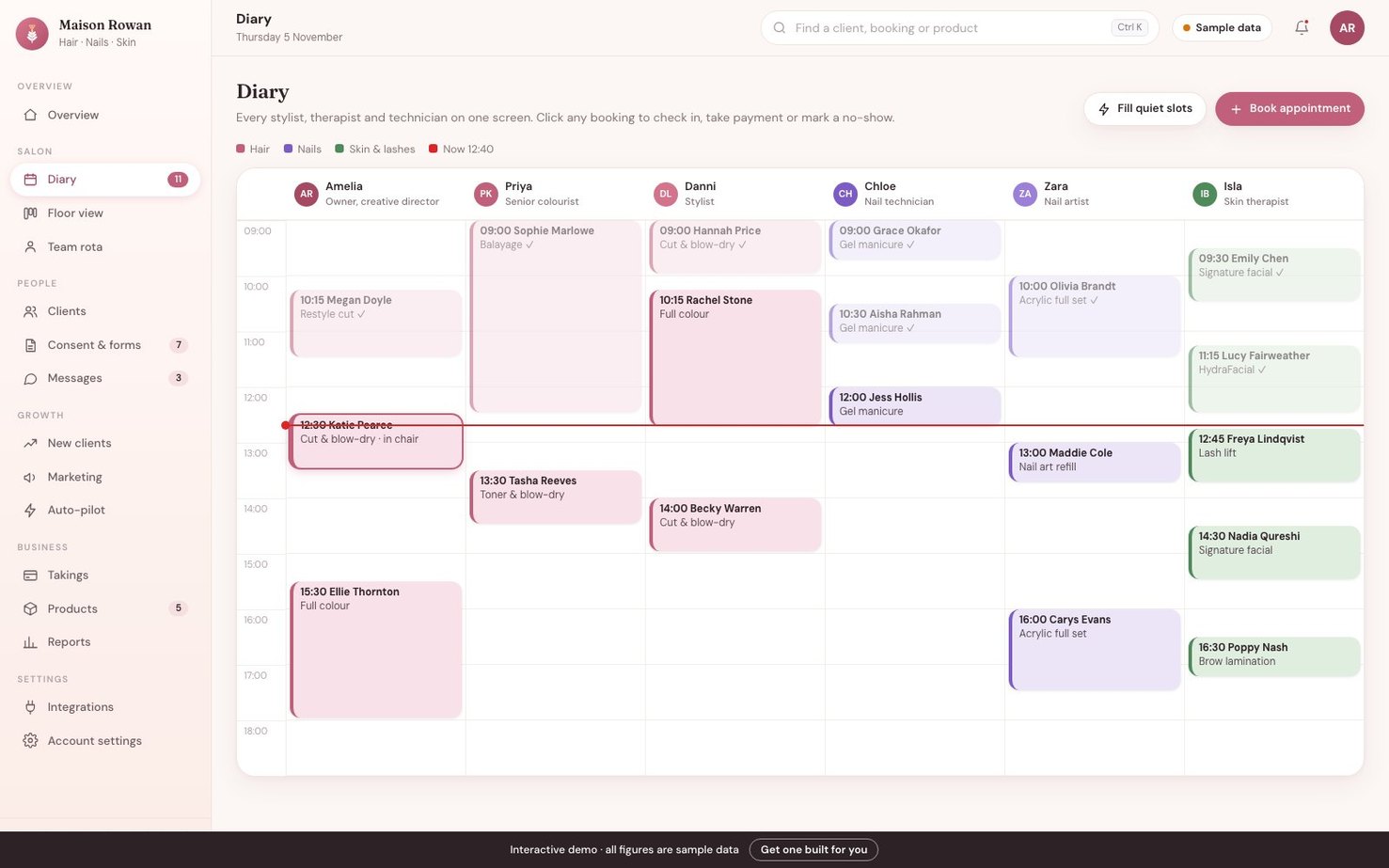
The same thinking drives our interactive demos. Our salon dashboard, for example, puts every stylist and therapist in one colour-coded diary, with reminders, deposits and rebooking nudges running on autopilot.
Your homework
Give it half an hour this week. List ten jobs, run the five questions and do the sum on the top one. Whatever the answer, you'll know more about where AI could help your business than any list of fifty tools could tell you.
Not sure where AI fits in your business? Book a free 20-minute chat.See our AI & automation service
Contact us →